Crisis communication: develop reflexes, not thick books
#crisiscommunication #crisismanagementplan
Are you really ready to face a crisis… or do you just think you are? Many organisations rely on comprehensive plans, but under pressure these often prove worthless. In a world of polycrises, where the rapid dissemination of information is crucial, there’s no time to waste.
Are your crisis plans user-friendly in the heat of the moment? Or do you have to trawl through a thick folder to work out the procedures?
We’re sharing a few tips to help you prepare your crisis management team efficiently for a crisis, as well as a handy tool.
Our tips:
Tip #1: Use short, action-oriented tools
Comprehensive crisis plans running to dozens of pages are rarely useful under pressure. So opt for:
- short checklists or action plans (1–2 pages)
- well-thought-out initial actions
- clear roles and responsibilities
- a focus on the first 60–90 minutes
This way, your team can act immediately, without having to interpret or search for information.
Did you know that our members can make use of our templates and tools? Request access here!
Tip #2: Train for speed and teamwork
Crisis management is a skill that you need to practise, not just work out on paper.
- Organise regular simulation exercises (including short exercises lasting 30–90 minutes)
- Test realistic scenarios, including new risks such as disinformation or AI
- Focus on coordination between teams, not just on individual roles
This is how you build reflexes that hold up under pressure.
Fancy an in-depth or short (table-top) simulation exercise? Click here for more information!
Tip #3: Use templates and tools
Preparation saves valuable time when every minute counts.
- Make sure you have crisis communication templates and tools ready, so you don’t have to start from scratch.
- Use AI as a sparring partner to step up a gear.
This allows you to react more quickly and stay focused on what really matters: the right message at the right time.
The content of these tips is based on Philippe Borremans’ keynote speech at the Lunch & Learn event on 4 June 2026.
Training course in the spotlight: Crisis Communication Workshop

Take the first steps towards a strong crisis communication plan
During the crisis communication workshop, we will review your communication plan (tone of voice, values, channels, stakeholders) and/or lay the foundations for a crisis communication plan.
We will explore strategies and best practices, and develop tools and templates based on two agreed scenarios.
Tool of the month
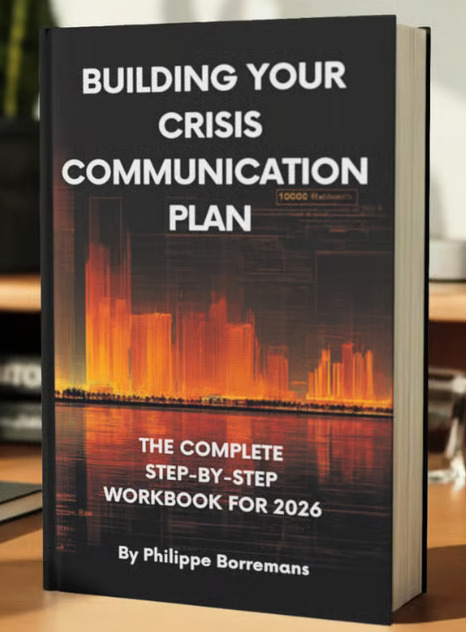
Philippe Borremans: Building Your Crisis Communication Plan, The Complete Step-By-Step Workbook for 2026
In this (work)book, Philippe Borremans uses his insights to guide you towards a hands-on, modern and practical crisis communication plan.
Find out more about the e-book!
Learning points

Extortion and internal threats: is your crisis management up to the task when faced with criminal acts?
The recent extortion case at baby food manufacturer HiPP shows that deliberate contamination is a real risk. However, criminal acts are not among the top priorities for food com...

4% affected, 60% unprepared: time for cyber resilience in the food sector
Food companies are therefore an attractive target, 60% of which do not have a Cyber Incident Response Plan. Moreover, warfare today takes place largely online. How can you bette...

Make sure you don’t become the poster boy for the crisis
Some crises affect an entire sector. How do you avoid becoming the face of the crisis? How do you coordinate strategic actions? Who takes the lead on crisis communication? Here ...